
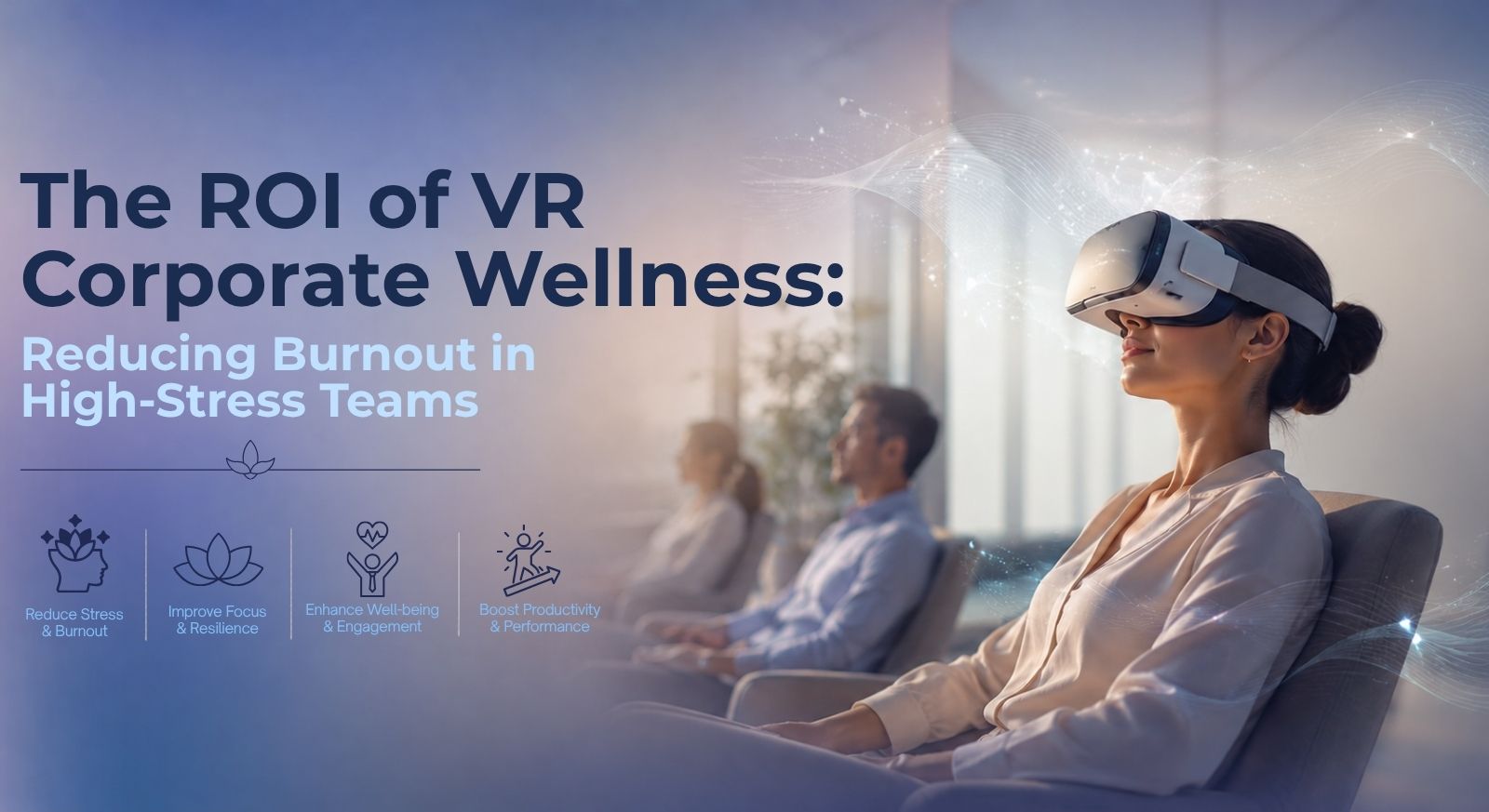

The ROI of VR Corporate Wellness: Reducing Burnout in High-Stress Teams
Consider a person in your team who is currently silently struggling to keep themselves going. They come through. They perform. But there is no spark anymore, and it will not be long before they either quit or collapse.
That is not a rare situation. The economic impact of burnout on American companies is estimated at $322 billion globally due to lost productivity. Moreover, high-stress work groups operating in such areas as healthcare, finance, legal services, and IT are adversely affected by burnout.
However, conventional solutions such as meditation apps, wellness sessions, and sporadic group lunches cannot resolve the issue. What the employees need is some kind of therapy that would provide the brain with a real respite from the environment that causes exhaustion. This is how virtual reality becomes relevant.
Why Wellness Apps Alone Can’t Fix High-Stress Teams

Standard wellness programs were not built for teams running at sustained high pressure. A breathing reminder app does not help a financial analyst preparing for an earnings call. A sleep webinar does not restore a nurse who has been on rotation for 12 hours straight.
High-stress teams have one thing in common: the brain never fully gets to switch off. Cortisol stays elevated. Focus erodes. And the culture often mistakes this depletion for dedication.
According to 2024 Gallup data, nearly half of American workers feel stressed every day, with burnout highest among mid-level employees. Burned-out managers are also far more likely to quit. For companies, that stress comes at a high cost, with over $10,000 lost per manager and more than $20,000 per executive each year from disengagement alone.
What VR Actually Does to a Stressed Brain

When an employee puts on a VR headset and enters a calm virtual space like a forest, beach, or mountain trail, the brain gets a break it simply cannot find at a desk. It reads the new environment as safe. The threat-response cycle that keeps stress hormones elevated finally gets interrupted.
This is no gimmick. Studies conducted in Frontiers in Organizational Psychology (2024) showed that the use of VR relaxation techniques was more effective in lowering stress and negative emotions compared to the use of 2D videos. One session of VR was found to significantly lower stress and anxiety levels in 43 healthcare professionals at South London and Maudsley NHS Foundation Trust.
In fact, even a 10-minute session makes a difference. This mental restoration will mean that decision-making and performance in the workplace improve for high-stress professionals.
Breaking Down the VR Corporate Wellness ROI

Here is where the title earns its keep. Let us look at what burnout actually costs versus what a VR wellness program actually requires.
The cost of doing nothing:
Replacing an employee costs 50% to 200% of their annual salary, according to SHRM (2025). Burned-out employees are twice as likely to leave. Healthcare costs run nearly 50% higher for workers under chronic stress. For a 100-person team with an average salary of $80,000 and even a modest 10% burnout-driven turnover rate, replacement costs alone reach $400,000 to $1.6 million per year.
The cost of a VR wellness program:
VR headsets for enterprise applications cost from $300 to $500 each. A shared headset will enable you to use 5 to 10 headsets for a team of 50 people, making your initial cost range from $1,500 to $5,000. The software used is either charged per employee or on a per-session basis.
What Cognihab structured programs deliver:
For a 100-person team spending $15,000 to $20,000 annually on a structured VR wellness program, the VR corporate wellness ROI reaches a positive return within the first year through absenteeism reduction and healthcare savings alone. That does not even count what it means to keep a high-performing manager from walking out the door.
The Science Behind Virtual Reality Burnout Prevention

The evidence for virtual reality burnout prevention has moved well past pilot studies.
According to a systematic review carried out in the Journal of Mental Health (2024) with respect to 17 works on workplace VR involving 1,270 subjects, there was consistent evidence of efficacy in stress, relaxation, and restoration. Immersive VR-based mindfulness is better than audio mindfulness by some margin, according to the BMC Digital Health (2025).
For teams carrying the most cognitive weight, the solution needs to match the depth of the problem. A short breathing video does not do that. Full sensory immersion does.
What an Employee Burnout VR Solution Looks Like in Practice

An employee burnout VR solution does not need a dedicated wellness room or a major IT rollout. Most organizations start simply.
A few shared headsets placed in a break room or quiet area can serve a team of 30 to 50 people running 10-minute on-demand sessions between meetings. Teams with known high-stress cycles, audit season, product launches, and clinical rotations can run structured twice-weekly programs with stress tracking built in. For hybrid and remote teams, headsets can be shipped directly to employees at home, making this one of the few wellness tools that works equally well off-site.
What makes it genuinely useful for HR is the data. Session frequency, duration, and self-reported stress scores are tracked and reportable, which means leadership gets real numbers instead of wellness survey guesses.
Making the Case: Corporate Wellness Technology ROI
When the conversation moves to the CFO, corporate wellness technology ROI needs to be framed as operational risk, not a wellbeing nicety.
Burnout accounts for $190 billion in annual U.S. healthcare costs. A company with 20 burned-out executives is losing over $400,000 per year in productivity drag before a single resignation. Against that baseline, a structured VR wellness program is not an expense. It is a risk management decision.
The Timing Edge: VR Stress Reduction in the Workplace

Most wellness programs are set up as annual benefits sitting quietly in the background. VR stress reduction in the workplace is most effective when deployed during peak stress windows, not as a general perk.
A legal team mid-case, a clinical team during flu surge, an engineering team before a product launch. These are the moments where 10 minutes in VR does something measurable. Stress builds in cycles, and high-stress teams know exactly when those cycles hit. Meeting them there is what separates programs that deliver results from those that report low engagement.
The Bottom Line
Burnout in high-stress teams is not a character flaw or a scheduling problem. It is a biological reality that generic wellness tools are not equipped to address.
VR corporate wellness ROI is now backed by peer-reviewed research, real implementation data, and a financial case that holds up under scrutiny. A 100-person team investing $15,000 to $20,000 annually in structured VR wellness is protecting against $400,000 to $1.6 million in burnout-driven turnover costs.
The people on your team running on empty do not need another webinar. They need 10 minutes somewhere their brain actually believes is safe.
Ready to Reduce Burnout with VR Wellness?
If you are looking to move beyond traditional wellness programs and actually address stress at a physiological level, VR-based solutions can help teams reset faster and perform better under pressure. Explore structured VR corporate wellness programs and see how measurable ROI is achieved in real workplaces with CogniHab.
.jpg)